
September Epistle: Free Indeed
A year and a half before the United States entered WWII, the army of Nazi Germany entered Paris. In May and June of 1940, German forces invaded Belgium, Luxembourg, the Netherlands and France. French and British divisions made a heroic stand on the Somme and Aisne rivers, but German forces prevailed, pushing deep into France and taking Paris unopposed on the 14th of June. Four years later, on August 25th, 1944, Paris was freed once again.
The battle to liberate the capital city began on August 19th, 1944, as French Resistance fighters staged an uprising against the German garrison in Paris. Allied forces then joined the French Resistance fighters in battling to oust the occupying German army. The word had come down from Berlin that the city was not to be relinquished, except as rubble. As the Allies had advanced on Paris, German troops had mined many important buildings and bridges, preparing for the city’s destruction. On August 23rd, and as the threat of an Allied victory loomed, Hitler ordered the city be reduced to rubble.
General Dietrich von Choltitz, however, had a great appreciation for the heritage and treasures of Paris. Believing an Allied victory inevitable, both in Paris and in Europe in general, he ignored Hitler’s order, preserving Paris and countless lives. Choltitz surrendered the German garrison on August 25th, and General de Gaulle of France arrived the same day to assume control of the capital. Paris was once again free.
On August 26th, the day after Paris was liberated, General de Gaulle and his entourage made their way down the Champs-Élysées to Notre-Dame Cathedral to attend a worship service, centered around the Magnificat. As it happens, there was still gunfire erupting sporadically from enemy resistance in the city. Undeterred, de Gaulle courageously made his way to the cathedral and took part in the service. In his memoirs, General de Gaulle describes
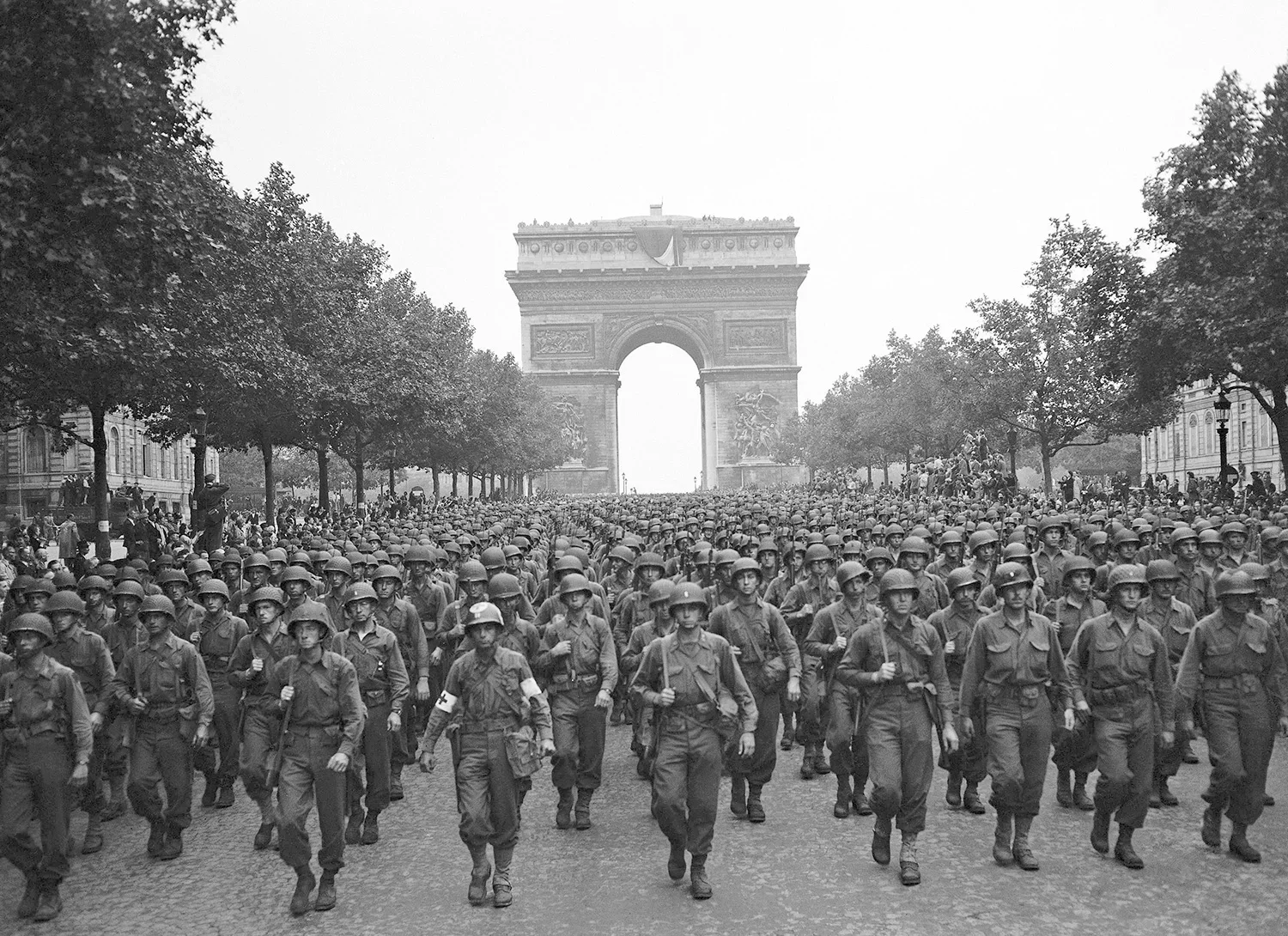
U.S. soldiers of Pennsylvania's 28th Infantry Division march along the Champs Elysees, the Arc de Triomphe in the background, on Aug. 29, 1944.
Following the liberation of the city, around 2,000,000 Parisians poured into the streets to celebrate and to witness a massive parade of victorious soldiers. Charles de Gaulle and his entourage stroll down the Chaps-Élysées to Notre-Dame Cathedral August 26, 1944. being moved as the people rejoiced together. He wrote, “The Magnificat rises. Was one ever sung more fervently?”
The Magnificat (sung by Mary, pregnant with baby Jesus, when visiting her cousin Elizabeth) begins: “My soul magnifies the Lord, and my spirit rejoices in God my Savior” (Luke 1:46-47). How appropriate it was for the people of the city and their leaders to give praise to God their liberation!
This past week was the 82nd anniversary of the liberation of Paris. The iconic city was delivered from under the heel of an occupying power. But Mary’s song, the Magnificat, rejoices that our merciful God has provided a Savior more valiant, more powerful, more courageous, than General de Gaulle. In Jesus Christ, all who believe in Him have been delivered from the domain of darkness and brought into God’s kingdom of light. The liberation of Paris is temporal, it is of this world, and not guaranteed to last. The liberation we have received in the life, death, and resurrection of our Savior is eternal. It reaches beyond the kingdoms of this world and into the kingdom of heaven, which has no end.
Colossians 1:13-14 says, “He has delivered us from the domain of darkness and transferred us to the kingdom of his beloved Son, in whom we have redemption, the forgiveness of sins.” Later in that same letter Paul writes, “You, who were dead in your trespasses and the uncircumcision of your flesh, God made alive together with him, having forgiven us all our trespasses, by canceling the record of debt that stood against us with its legal demands. This he set aside, nailing it to the cross. He disarmed the rulers and authorities and put them to open shame, by triumphing over them in him” (Colossians 2:13-15)
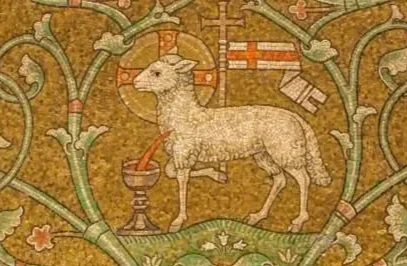
Agnus Dei, mosaic, Dormition Abbey, Jerusalem.
The people of Paris had not “deserved” to be occupied. They didn’t merit having their freedoms taken away. But the mountain of debt that our sin has accrued stood against us. Its legal demand was a death sentence. Fear and death reigned until Christ claimed that the debt we owed was His. He bore the responsibility, He carried that burden to the cross, and there He became the sacrifice that made us whole, that proclaimed us not guilty and set us free.
The writer to the Hebrews says, “Since therefore the children share in flesh and blood, he himself likewise partook of the same things, that through death he might destroy the one who has the power of death, that is, the devil, and deliver all those who through fear of death were subject to lifelong slavery” (Hebrews 2:14-15). Though we were once in slavery to sin and languishing in the kingdom of Satan, we have been liberated, set free, by the death and resurrection of Jesus Christ.
And so, we gather together with our fellow Christians, even while the enemy still fires his shots. He prowls around in this world like a roaring lion, but from him we have nothing to fear. “If the Son sets you free, you will be free indeed” (John 8:36). Christ is the victor. And that victory is ours, now and forever.
““My soul magnifies the Lord, and my spirit rejoices in God my Savior” God’s peace be with you,
- Pastor