
February Epistle: Ephesus, A Seventh Excursion in Greece
The city of Ephesus is situated on the south-western coast of modern-day Turkey. It was first founded in the 10th century BC by Greek colonists. During the Classical Greek era (5th to 2nd century BC), it was one of twelve cities that came together in the Ionian League, the first banding together of city-states for mutual protection. The city was brought under Roman rule in 129 BC. In its heyday, Ephesus was famous for its grand temple of the female goddess, Artemis. People traveled long distances on pilgrimage to pay homage to this local deity. Artemis of the Ephesians was known as a fertility goddess and a goddess of animals. She was a source of pride for the Ephesians and an economic engine as well. The original temple is believed to have been built in the 8th century BC, but was destroyed in a flood in the 7th. It lay in ruins for at least 150 years before construction began on a new and grander temple in 550 BC. This new temple is thought to have been the first Greek temple built using marble, with a double row of columns 40 ft tall around the 377 ft long, 151 ft wide perimeter. The second temple was also destroyed, this time by a man named Herostratus who, in order to make a name for himself, set fire to the roof beams in 356 BC.
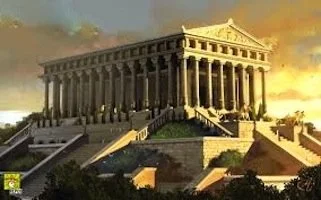
Artist’s rendering of the 3rd Temple of Artemis
A third temple, even more massive, was then constructed. This temple had 127 pillars 60 ft high in two rows around an even larger footprint, 450 by 225 ft. The temple housed an enormous golden statue of Artemis and was so impressive that an ancient Greek poet named Antipater of Sidon wrote in the 2nd century BC:
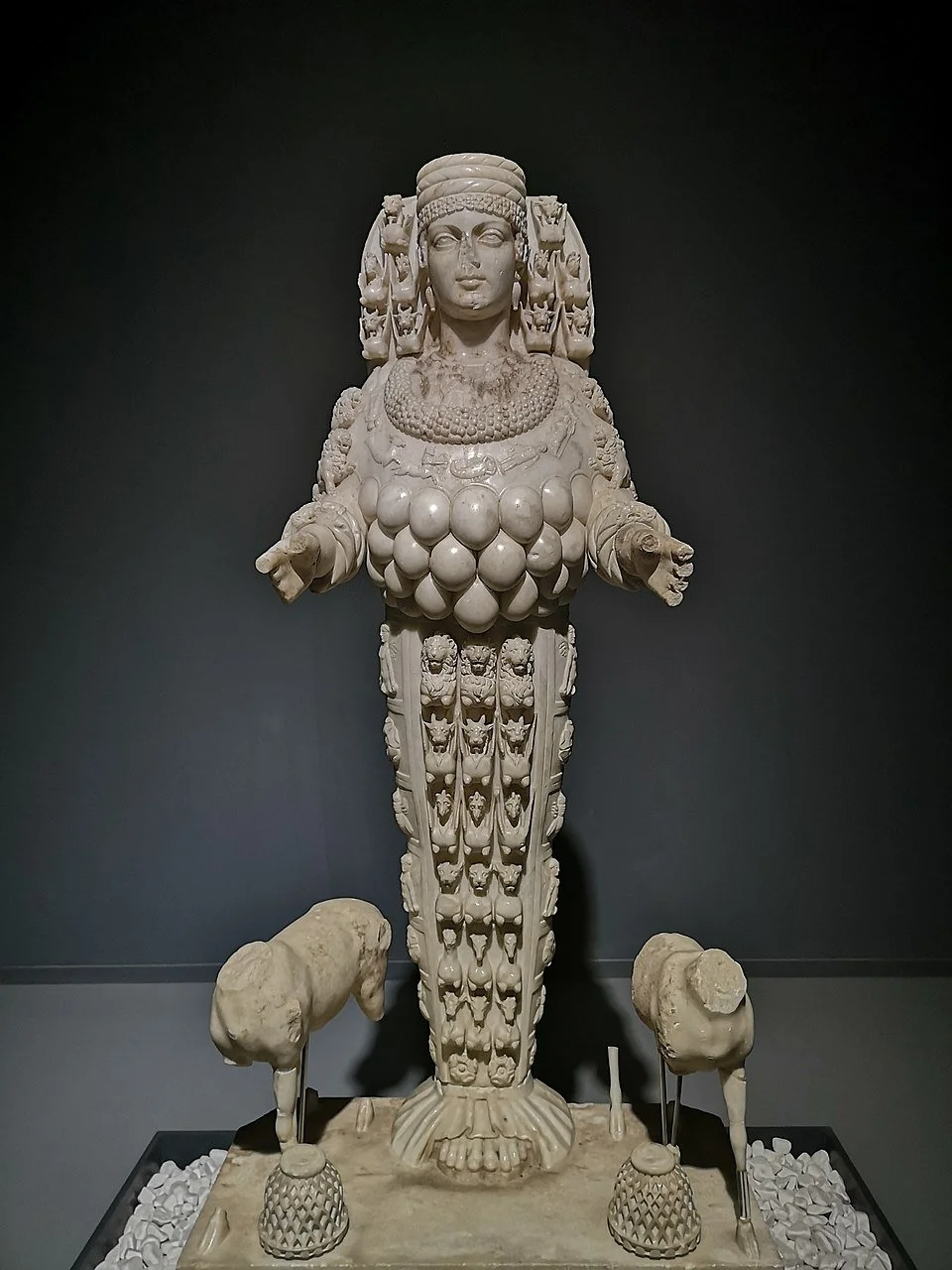
Artemis of the Ephesians, goddess of fertility and animals
“I have set eyes on the wall of lofty Babylon on which is a road for chariots, and the statue of Zeus by the Alpheus, and the hanging gardens, and the Colossus of the Sun, and the huge labor of the high pyramids, and the vast tomb of Mausolus; but when I saw the house of Artemis that mounted to the clouds, those other marvels lost their brilliancy, and I said, ‘Lo, apart from Olympus, the Sun never looked on aught so grand.”
The main street of Ephesus must have been quite a sight in its day. The gently sloping roadway was paved with beautiful marble slabs and led visitor and resident alike past numerous shops, temples, ornate carvings, stairways, etc. It is quite something for tourists today to be able to walk that same street as it winds gently downward past excavated ruins of the once dazzling center of commerce of this ancient city. Ephesus is somewhat unique as an archaeological site because no modern city was ever built on its ruins. The Main street in Ephesus in Paul’s day. (2nd of three cities of Ephesus) The façade of the Celsus Library is in the distance, built after Paul. A new port was built on the same river. The location of the city actually moved twice. The original city was built at the mouth of the Cayster River, which emptied after a few miles into the Aegean Sea. When the flow of the river silted the port and the ensuing marsh caused outbreaks of malaria, Ephesus was moved a little over a mile to the southwest, where a new port was built on the same river.
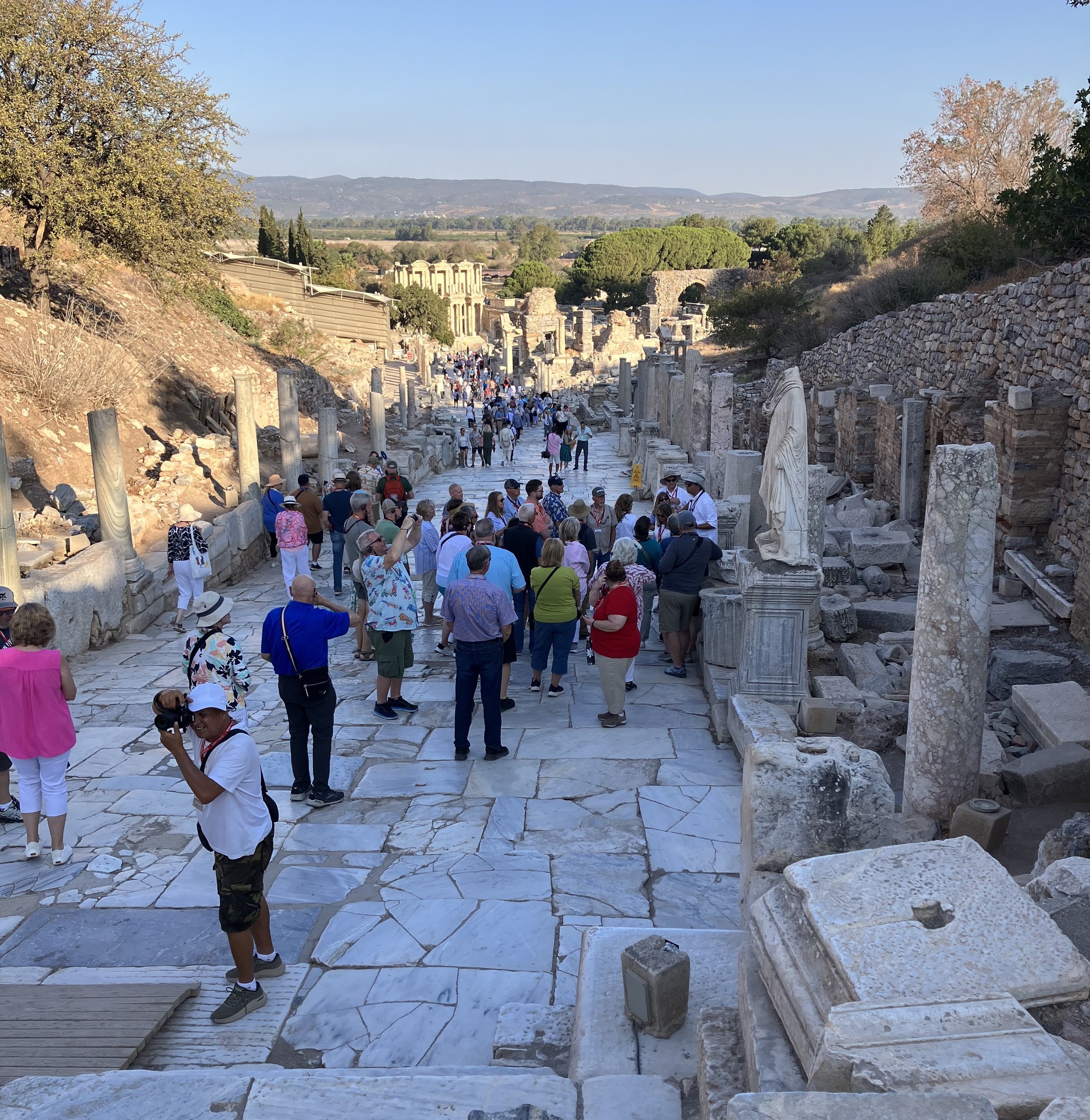
Main street in Ephesus in Paul’s day. (2nd of three cities of Ephesus). The façade of the Celsus Library is in the distance, built after Paul.
This is the port that St. Paul would have known. The Romans maintained this port for 600 years when, once again, silting from the Cayster River overwhelmed their efforts. The city’s location was again abandoned and Ephesus was relocated, this time above the marshy plain. For this reason, the ruins of Paul’s Ephesus do not lie under a modern city, but lie in the open, buried by time, and inviting the archaeologists’ reclamation.
The Ephesus of antiquity was one of the largest Roman cities. While in Paul’s day it was famous for its Temple of Artemis, the city would come to have many other buildings of note as well. A very impressive library was commissioned by a wealthy Senator named Celsus to be his mausoleum. It was completed around 120 AD by his son after Celsus’ death. The library held some 12,000 scrolls on wooden shelves in the walls around a central open area. The entire library was well lit by great windows which faced east. It was an architectural marvel and one of the great libraries of antiquity. It was abandoned when the city was relocated, and destroyed by an earthquake in the 10th or 11th century. It lay in ruins until 1970, when archaeologists again raised the impressive façade.
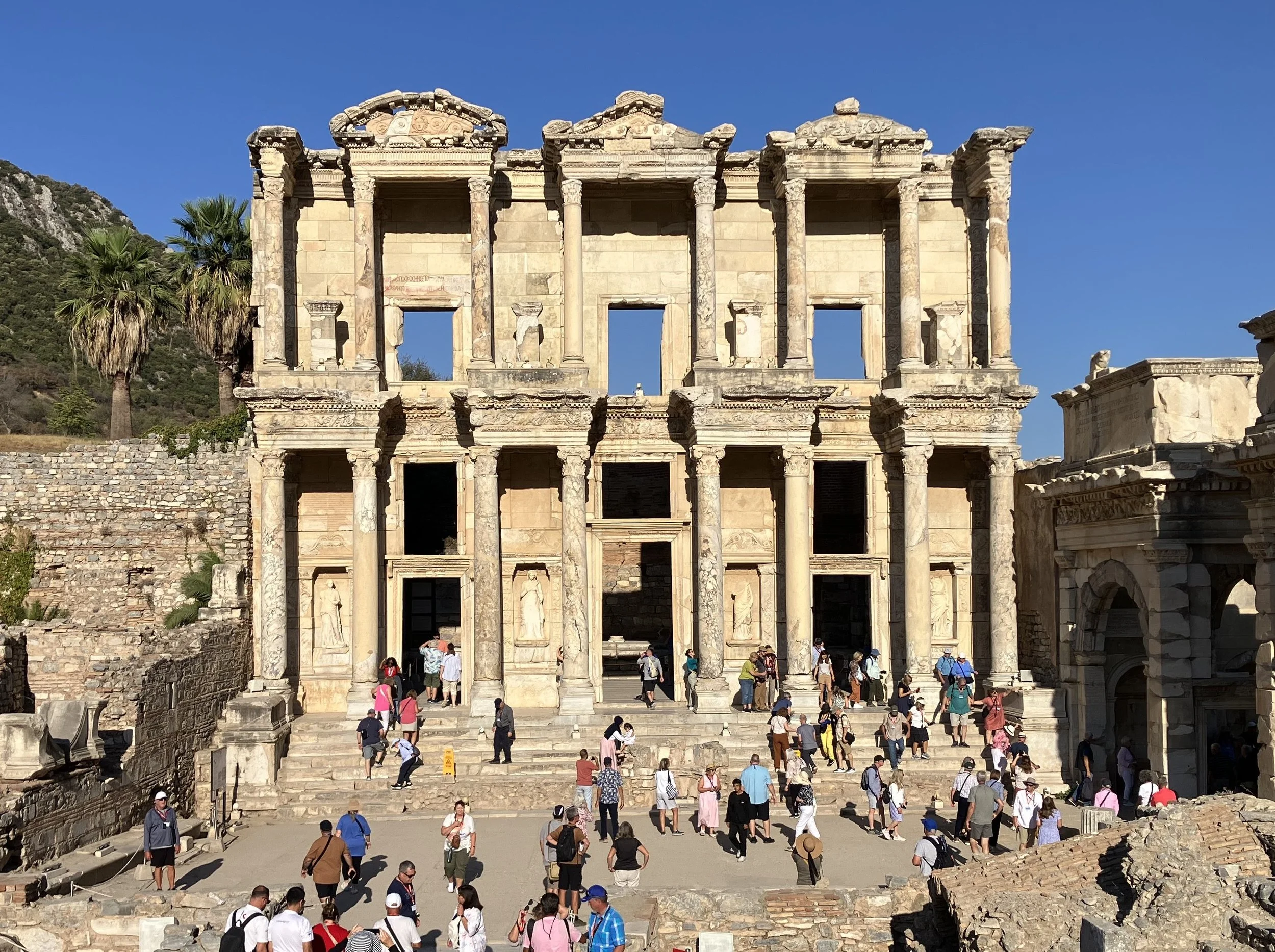
Façade of the Library of Celsus, built after Paul.
St. Paul spent three years in Ephesus on his third missionary journey. Dr. Paul Maier in his book, “In the Fullness of Time,” states that “Ephesus was a rich commercial center like Corinth, yet it also sheltered the wildest collection of pagan priests, exorcists, magicians, religious prostitutes, cultists, and charlatans in the Roman Empire.” For the first few months Paul reasoned with those attending the synagogue in Ephesus and preached Christ. But opposition to his message grew, and Paul moved with those who had believed the Gospel and began meeting in the “hall of Tyrannus” (Acts 19:9) where he was able to speak freely. One Greek manuscript of Acts states that this took place between the 5th and the 9th hours of the day – 11:00 in the morning to 4:00 in the afternoon. Likely, Paul was able to rent the hall cheaply during the heat of the day, presumably after Tyrannus’ students had left.
Acts chapter 19 continues at verse 11 with:
“And God was doing extraordinary miracles by the hands of Paul, 12 so that even handkerchiefs or aprons that had touched his skin were carried away to the sick, and their diseases left them and the evil spirits came out of them. 13 Then some of the itinerant Jewish exorcists undertook to invoke the name of the Lord Jesus over those who had evil spirits, saying, “I adjure you by the Jesus whom Paul proclaims.” 14 Seven sons of a Jewish high priest named Sceva were doing this. 15 But the evil spirit answered them, “Jesus I know, and Paul I recognize, but who are you?” 16And the man in whom was the evil spirit leaped on them, mastered all of them and overpowered them, so that they fled out of that house naked and wounded. 17And this became known to all the residents of Ephesus, both Jews and Greeks. And fear fell upon them all, and the name of the Lord Jesus was extolled. 18Also many of those who were now believers came, confessing and divulging their practices. 19And a number of those who had practiced magic arts brought their books together and burned them in the sight of all. And they counted the value of them and found it came to fifty thousand pieces of silver. 20 So the word of the Lord continued to increase and prevail mightily.”
“About that time there arose no little disturbance concerning the Way. 24 For a man named Demetrius, a silversmith, who made silver shrines of Artemis, brought no little business to the craftsmen. 25 These he gathered together, with the workmen in similar trades, and said, “Men, you know that from this business we have our wealth. 26And you see and hear that not only in Ephesus but in almost all of Asia this Paul has persuaded and turned away a great many people, saying that gods made with hands are not gods. 27And there is danger not only that this trade of ours may come into disrepute but also that the temple of the great goddess Artemis may be counted as nothing, and that she may even be deposed from her magnificence, she whom all Asia and the world worship.”
28 When they heard this they were enraged and were crying out, “Great is Artemis of the Ephesians!” 29 So the city was filled with the confusion, and they rushed together into the theater, dragging with them Gaius and Aristarchus, Macedonians who were Paul's companions in travel. 30 But when Paul wished to go in among the crowd, the disciples would not let him. 31And even some of the Asiarchs, who were friends of his, sent to him and were urging him not to venture into the theater. 32 Now some cried out one thing, some another, for the assembly was in confusion, and most of them did not know why they had come together. 33 Some of the crowd prompted Alexander, whom the Jews had put forward. And Alexander, motioning with his hand, wanted to make a defense to the crowd. 34 But when they recognized that he was a Jew, for about two hours they all cried out with one voice, “Great is Artemis of the Ephesians!”
The theater into which the crowd streamed was constructed in Ephesus late in the 3rd century BC, and expanded by Rome by Paul’s day to seat around 24,000 people. You can imagine the great echoing cries of the Ephesians as the thousands in the riotous crowd chanted “Great is Artemis of the Ephesians!” for two solid hours. The town clerk had to come and quiet the crowd (35-41):
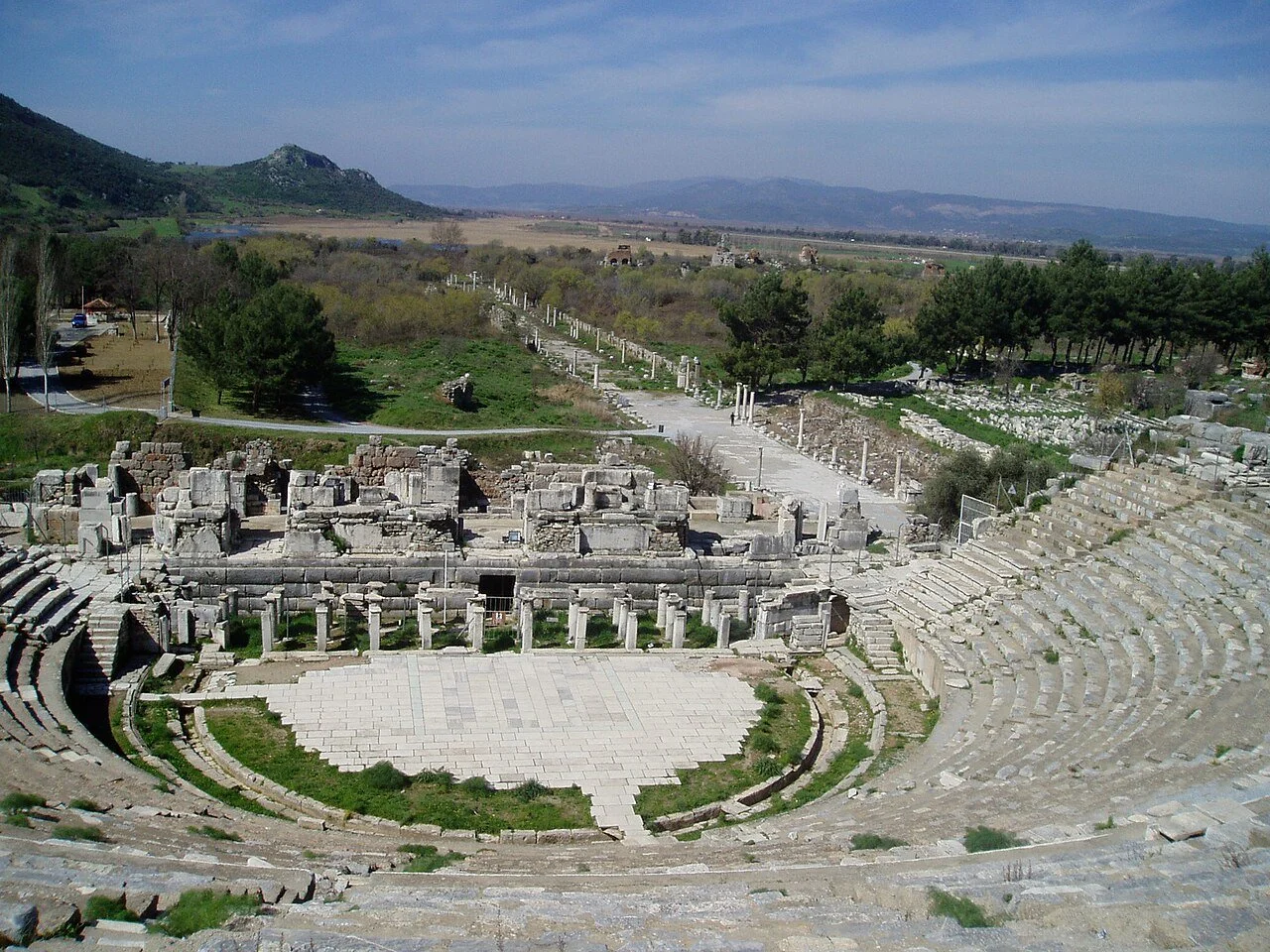
Great theater of Ephesus
“He said, “Men of Ephesus, who is there who does not know that the city of the Ephesians
is temple keeper of the great Artemis, and of the sacred stone that fell from the sky? 36 Seeing then that these things cannot be denied, you ought to be quiet and do nothing rash. 37 For you have brought these men here who are neither sacrilegious nor blasphemers of our goddess. 38 If therefore Demetrius and the craftsmen with him have a complaint against anyone, the courts are open, and there are proconsuls. Let them bring charges against one another. 39 But if you seek anything further, it shall be settled in the regular assembly. 40 For we really are in danger of being charged with rioting today, since there is no cause that we cangive to justify this commotion.” 41And when he had said these things, he dismissed the assembly.”
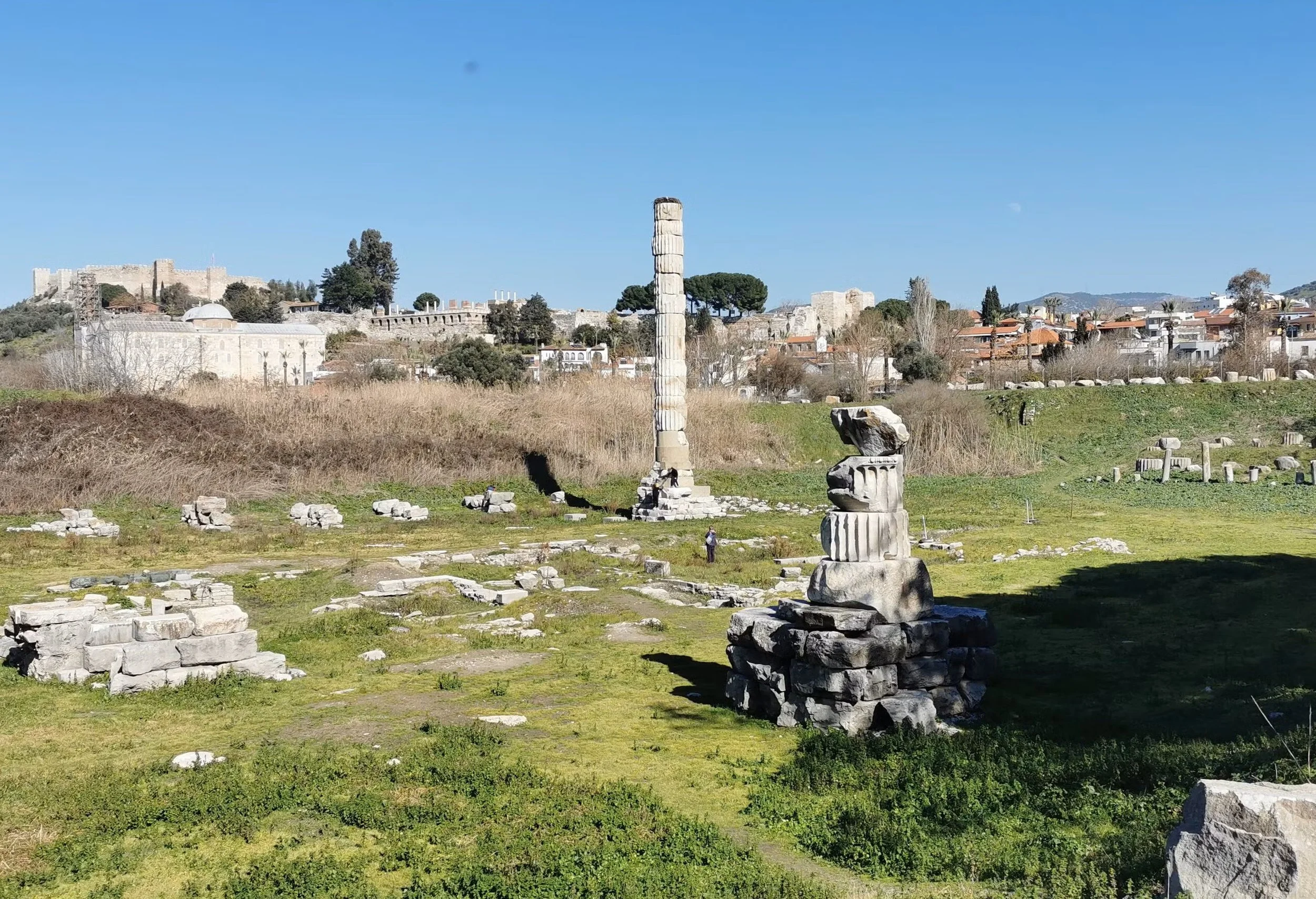
Ruins of the Temple of Artemis
Paul reasoned with his hearers from the Scriptures. He spoke of having met the risen Christ. The Christian faith is founded in truth and in history. The Ephesians could only chant “Great is Artemis of the Ephesians” like loyal fans. But where is Artemis today? What power did she hold? What truth was in their claims of greatness? The Temple of Artemis is no more. Today, a lone pillar set up by archeologists marks the place where the world once came to pay homage to a god made with human hands. And what of the great city of Ephesus? Its marvelous buildings lie toppled and in ruins.
And yet, it is exciting to walk those streets, to sit in the marketplace (agora) of ancient Ephesus and read from the book of the Acts of the Apostles how for three years Paul spoke to the people about Jesus, and about what He had done in shedding his blood and rising from the dead to bring us forgiveness and eternal life.
Our God is great, but He does not live in marbled halls. He is not great because His followers can out-shout those of other religions. Our God is great because He is faithful; He fulfills His promises. Our God is great because He is Love, because He gladly took our flesh upon Himself, to live and to die to redeem mankind from death and hell.
Perhaps Paul has the Temple of Artemis in mind when he later writes to the Ephesians, “You are… fellow citizens with the saints and members of the household of God, built on the foundation of the apostles and prophets, Christ Jesus himself being the cornerstone, in whom the whole structure, being joined together, grows into a holy temple in the Lord. In him you also are being built together into a dwelling place for God by the Spirit” (Eph. 2:19-22).
The image of Artemis in her temple was imposing. It created awe and drew people to her. But, again, Paul writes the Church in Ephesus, “For this reason I bow my knees before the Father (in prayer)… that according to the riches of his glory he may grant you to be strengthened with power through his Spirit in your inner being, so that Christ may dwell in your hearts through faith – that you, being rooted and grounded in love, may have the strength to comprehend with all the saints what is the breadth and length and height and depth, and to know the love of Christ that surpasses knowledge, that you may be filled with all the fullness of God” (Eph. 3:14-19). God’s love is vast, incomprehensible, far greater than Artemis or any other impotent deity.
Paul writes to the Ephesians and to us, “You were dead in the trespasses and sins in which you once walked, following the course of this world, following the prince of the power of the air, the spirit that is now at work in the sons of disobedience— among whom we all once lived in the passions of our flesh, carrying out the desires of the flesh and the mind, and were by nature children of wrath, like the rest of mankind. But God, being rich in mercy, because of the great love with which he loved us, even when we were dead in our trespasses, made us alive together with Christ—by grace you have been saved— and raised us up with him and seated us with him in the heavenly places in Christ Jesus, so that in the coming ages he might show the immeasurable riches of his grace in kindness toward us in Christ Jesus. For by grace you have been saved through faith. And this is not your own doing; it is the gift of God, not a result of works, so that no one may boast. For we are his workmanship, created in Christ Jesus for good works, which God prepared beforehand, that we should walk in them” (Eph. 2:1-10).
Paul spoke the truth – gods made with hands are not gods. And through the work of Paul and others (Priscilla, Aquila, Apollos, and later, John) the Christian Church in Ephesus would flourish, becoming a hub for Christianity in Asia Minor.
Praise God for His lovingkindness to us in sending Jesus to be our Savior. Praise God for the work of Paul and others in preaching Christ crucified and risen from the dead. Praise God that he has joined you with fellow believers of all time, building us together into a holy temple in the Lord.
God be with you all.
-Pastor