
January Epistle: Thessaloniki, A Sixth Excursion in Greece
Modern Thessaloniki is located in northern Greece, (Macedonian area), on the Aegean Sea. It was originally founded in 315 BC by King Cassander of Macedon, whose rule followed Philip II (reigned 359-336 BC) and his son, Alexander the Great (336-323 BC). Cassander named the city Thessalonike after his wife, who was the half-sister of Alexander the Great, of whom Cassander was a contemporary, serving under him as a general. The name means “Victory of Thessalians”. She was so named having been born the day after her father, Philip II, had been victorious in battle with the help of Thessalian horsemen (“nike” is Greek for “victory”).
The Via Egnatia, an ancient Roman road constructed in the 2nd century BC, passes through Thessaloniki. This road facilitated trade between Europe and Asia and enabled the city to grow into an important trading hub. Today, Thessaloniki is home to over 800,000 people, and is the second most populous city in Greece. Only Athens outranks it with a population over 3,000,000.
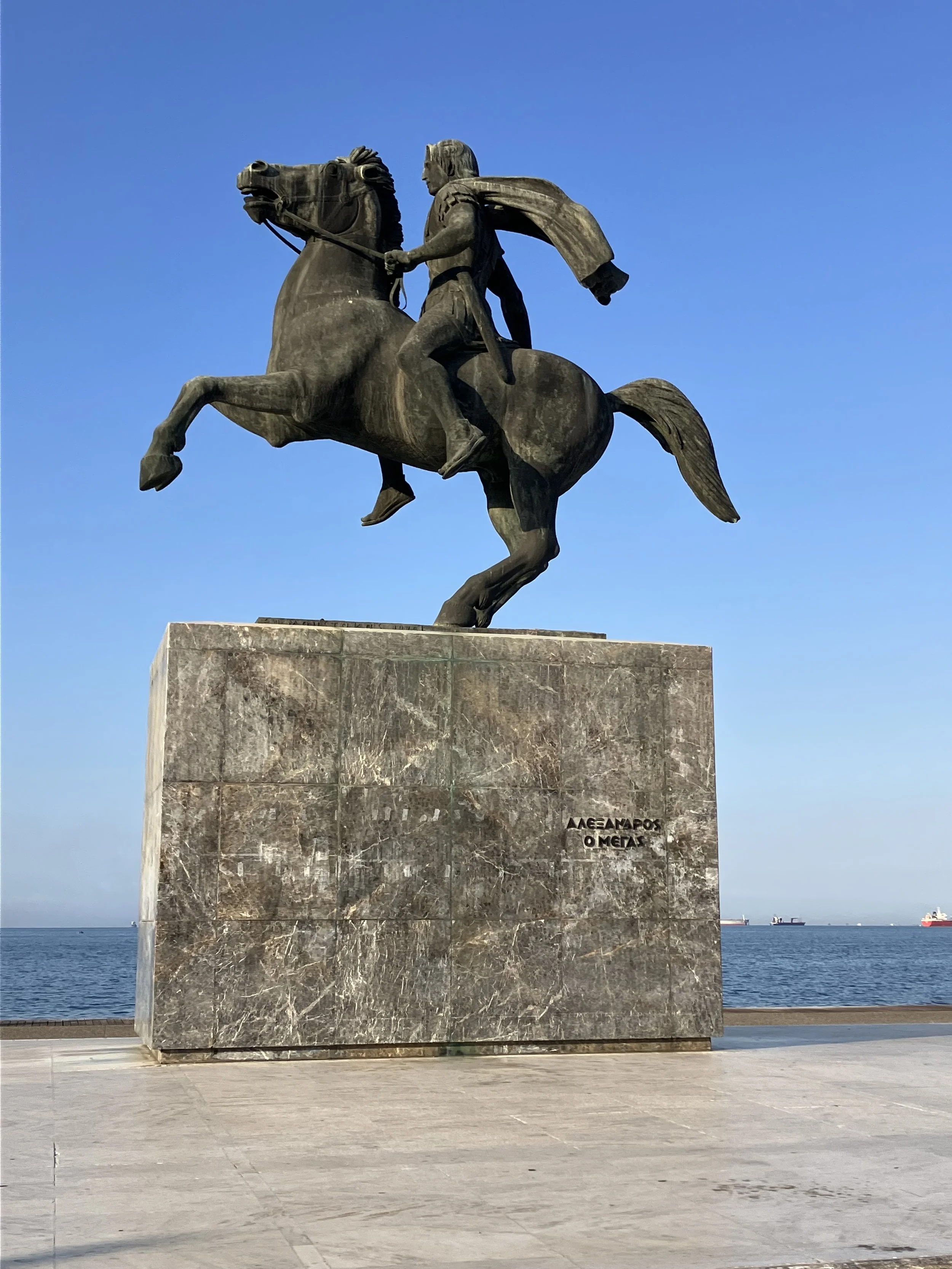
At the center of the waterfront sits an impressive 4-ton bronze statue of Alexander the Great, facing east, as if he looks to conquer more lands. The statue is recent (1973), and pays homage to the one who brought Hellenization (Greek language and culture) and stability to the entire region, which created circumstances conducive to the growth and prosperity of Thessaloniki.
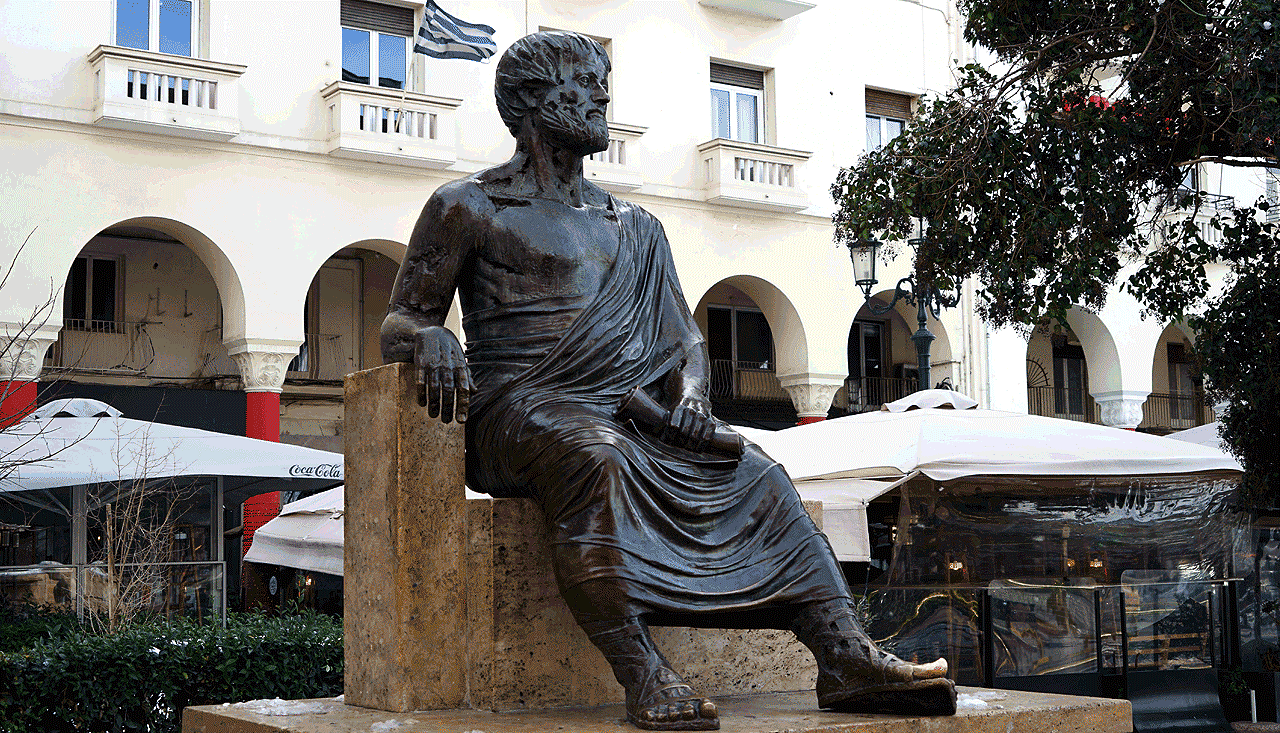
It is interesting to note that both Cassander and Alexander the Great were students of Aristotle. Perhaps this is why the city incorporated an open square into its redesign after a great fire in 1917, naming it Aristotelous Square. It is understood that Aristotle’s accomplishments and methodology set the groundwork for the development of modern science. In 1990, a bronze statue of the famous philosopher and master of many subjects was placed in the square named for him.
The Arch of Galerius is situated near the waterfront and spans the Roman Via Egnatia. In 298 AD, the arch was commissioned by the Roman emperor Galerius upon defeating Narses, ruler of the Persian Empire. Marble panels in the arch can still be seen depicting celebrations of this victory. The arch was completed in 299 AD. Seven years later, in 306 AD, Galerius had a mausoleum built where he planned to be entombed.
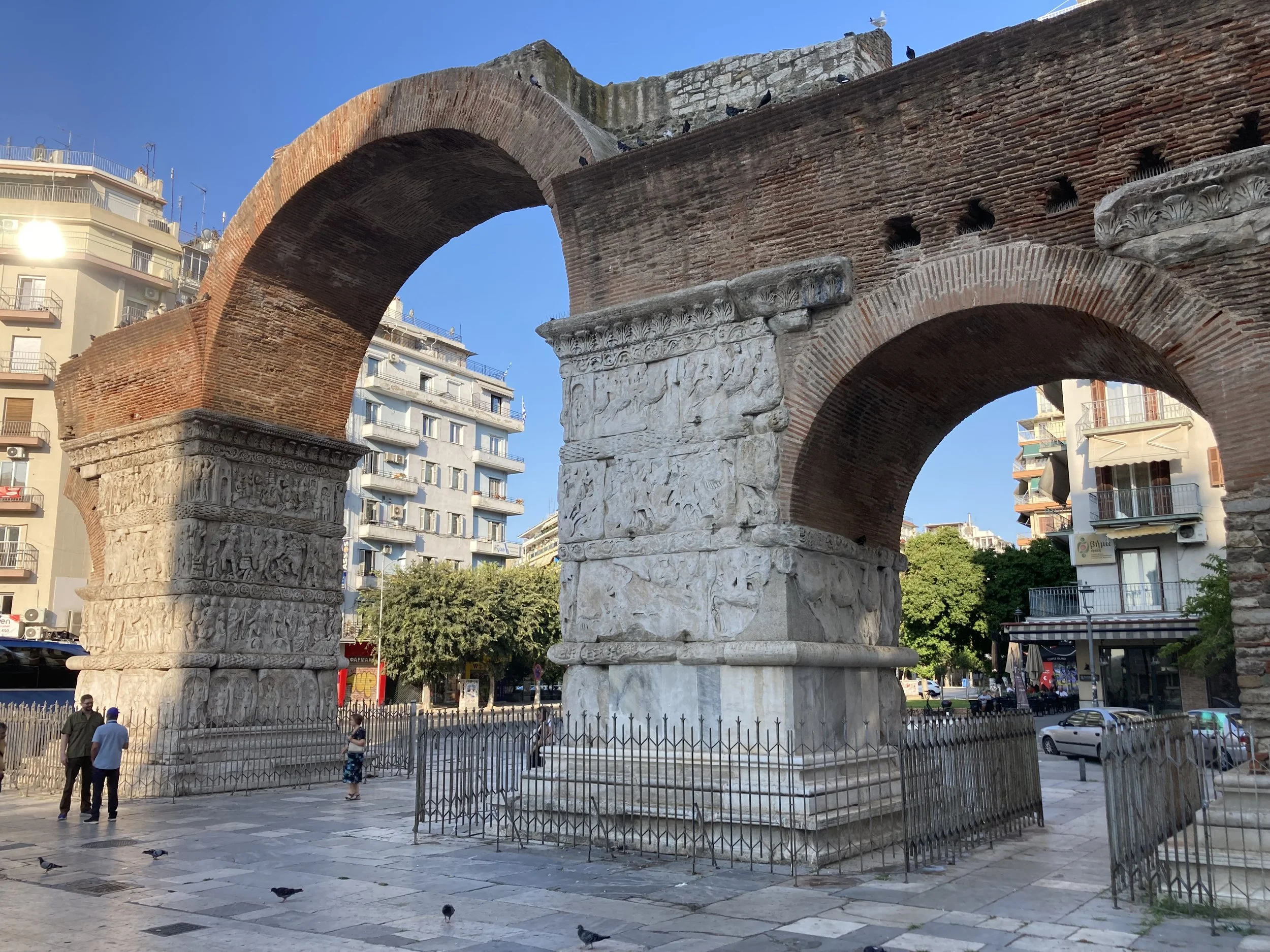
Arch of Galerius over the Via Egnatia, 299 AD
This mausoleum is situated not far from the arch, and was connected to it by a short road. Galerius died five years after the mausoleum was completed. However, he was actually buried some 500 miles to the northwest in Serbia at his birthplace. The mausoleum/rotunda was empty for several decades before becoming a Christian church in the late fourth century. It remained a church until the city fell to the Ottomans in 1590, when it was converted into a mosque; the mosque’s minaret (tower) remains to this day. The rotunda remained a mosque until 1912 when the Greeks again took control of Thessaloniki and converted it back into a Christian church.
Paul and Silas, when they were released from the prison in Philippi, traveled on to Thessaloniki. This was Paul’s second missionary journey, likely in 51 AD, 250 years before Galerius became emperor. They entered the synagogue where Paul began reasoning with the Jews from the Scriptures, explaining and proving that Jesus was the Christ, and that it was necessary that he suffer, die and rise from the dead. Some of the Jews believed, and many of the Greeks, also. Jealous of these conversions, the Jews of the synagogue went looking for Paul and Silas. They gathered a mob and attacked the house of a Christian Jew named Jason. As they did not find them there, they dragged Jason and some of the others who had believed, and brought them before the authorities. They argued that Paul and Silas, and now Jason, were turning the world upside down, acting against Caesar, and claiming that there was another king named Jesus. Jason was released on bond, and those who had believed sent Paul and Silas away that night. The Gospel had come to Thessaloniki!
What a contrast we find in the might and power of Alexander the Great, displayed in the bronze statue for all to see, and the frail child born to the virgin, Mary. Alexander the Great conquered an enormous territory, and created a massive empire. He died young, at the age of 32. Jesus, also died young, about 33 years old. He had no territory, no place even to lay his head. Only a small band were following him.

19th century depiction of Alexander’s funeral procession
Alexander's body was laid in a gold sarcophagus filled with honey, which was in turn placed in a gold casket and paraded in a great procession. Galerius built a large and ornate mausoleum for his burial place. Jesus’ body was removed from the cross by a few humble people, and laid in a borrowed tomb. The mausoleum of Galerius was empty because his body was buried elsewhere. Jesus’ tomb was empty because he had risen from the dead!
As we stand on the brink of a new year, we are reminded that time is passing, and with it this world’s age. Men in this world work to make names for themselves. But the strength of man is nothing. The founding of cities and empires and the great achievements of man are nothing. Men die and cities fall into ruin. Empires rise and fall. Only the Word of God remains. His promises and their fulfillment are eternal. Christ, the Word made flesh, has come to redeem us by His blood. Alexander the Great Hellenized the world, but did nothing to restore fallen creatures to God their Creator. Jesus was rejected by the world, but he made a way for the world to be saved through faith in Him.

The Descent from the Cross, Rogier van der Weyden, c. 1435 AD
God loves His world and has been working through people and events from the beginning of time to bring about his plan of salvation. The gift of the Savior is a lasting gift that will see us through the coming year and beyond. As you make your resolutions and ring in the new year, make God part of those plans. Go to church. Read His Word. Pray, praise and give thanks to the One who gave you more than fleeting culture and language; He has given you eternal life!
- Pastor
“And we know that for those who love God all things work together for good, for those who are called according to his purpose.” Romans 8:28
“For God so loved the world, that he gave his only Son, that whoever believes in him should not perish but have eternal life.” John 3:16